
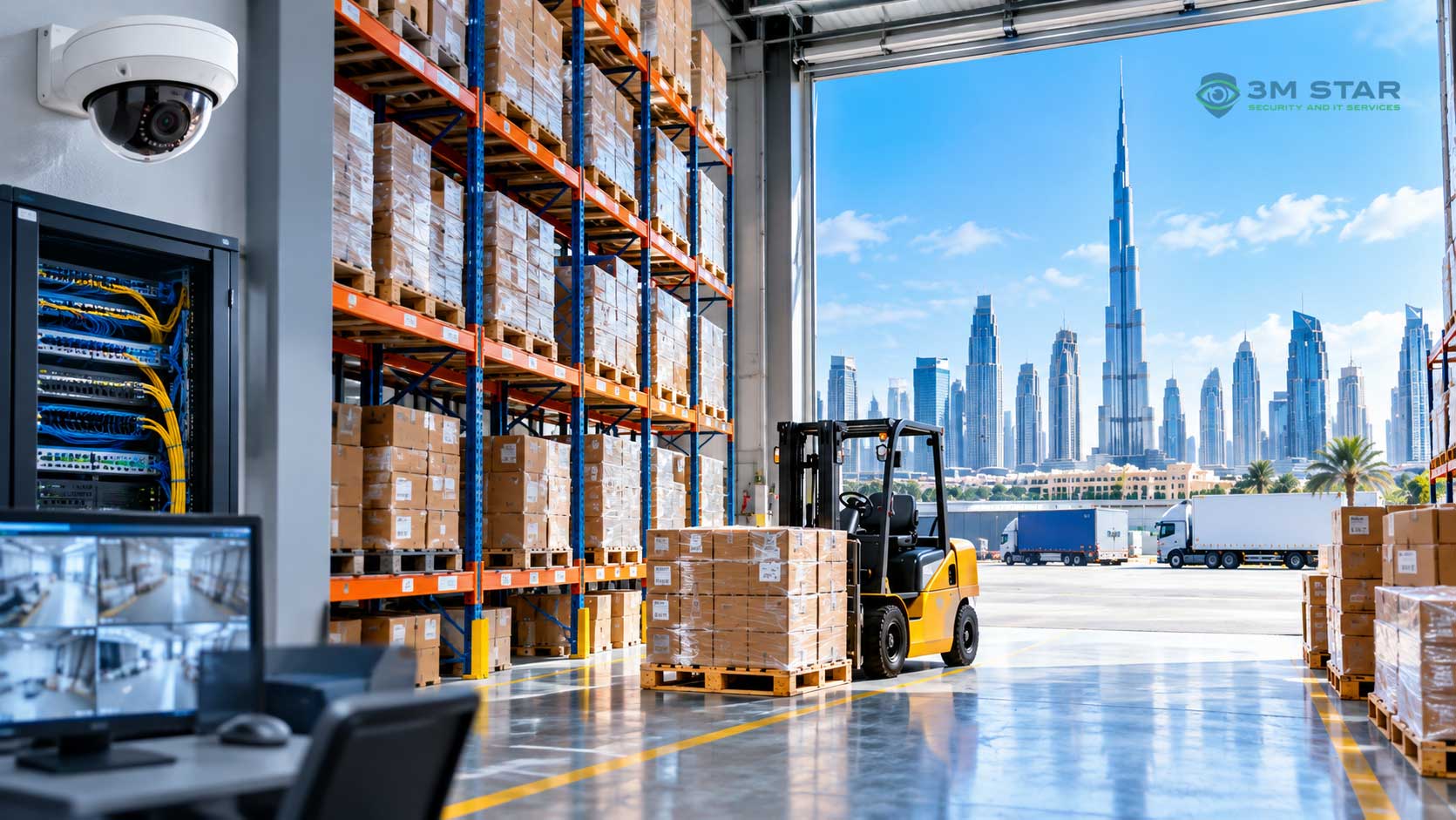
How to Set Up a Warehouse in Dubai: Requirements, Costs & Security (2026)
Setting up a warehouse in Dubai requires more than finding a suitable property. Business owners must consider licensing, warehouse location, storage operations, fire safety, CCTV security, network infrastructure, employee management and ongoing technical support.
Whether you are establishing an e-commerce fulfilment centre, a distribution facility, a third-party logistics (3PL) warehouse or a commercial storage business, the right planning can help improve operational efficiency, protect inventory and reduce avoidable infrastructure costs.
3M Star Computers LLC provides technology and security solutions for commercial facilities in Dubai, including CCTV installation, SIRA-related security systems, structured cabling, fibre splicing, networking, Wi-Fi, servers, data storage, biometric attendance, PABX telephone systems and annual maintenance contracts.
This guide explains how to set up a warehouse in Dubai, the approvals and infrastructure to investigate, the nine essential technology service areas to consider, the main cost factors and the questions business owners should answer before opening a warehouse.
Quick Answer: How Do You Set Up a Warehouse in Dubai?
To set up a warehouse in Dubai, define your business activity, confirm the appropriate trade licence, choose suitable premises, verify applicable safety and security requirements, and plan the technology infrastructure needed to operate the facility.
The main steps are:
- Define your warehouse business model and activities.
- Confirm the mainland or free zone licensing route.
- Select a suitable warehouse location and premises.
- Check building, fire safety and other applicable approvals.
- Assess CCTV coverage and any relevant SIRA requirements.
- Plan structured cabling, fibre connectivity, networking and Wi-Fi.
- Configure inventory systems, servers, storage and data backups as required.
- Set up employee attendance and business communications.
- Test all systems and arrange ongoing maintenance.
Important: Requirements vary according to the business activity, location, stored goods, building classification and applicable authorities. Confirm your specific licensing, security and safety obligations before starting operations.
Key Takeaways
- Warehouse licensing depends on the intended business activity and the relevant jurisdiction.
- Warehouse location, loading access, storage layout and connectivity should be assessed before signing a lease.
- CCTV and SIRA requirements should be verified for the specific facility rather than assumed to be identical for every warehouse.
- Reliable networking, Wi-Fi and structured cabling support inventory systems, handheld scanners, cameras and other connected equipment.
- Server, storage and backup requirements depend on the applications and data the business needs to manage.
- Biometric attendance and PABX systems can support workforce management and internal communications.
- Planned maintenance helps keep critical technology operational.
- A coordinated infrastructure plan can reduce installation rework and make future expansion easier.
1. Decide What Type of Warehouse Business You Want to Establish
The first step is to identify what your warehouse will store and which services it will provide. Your business model affects licensing, premises, equipment, operational procedures and technology requirements.
Common warehouse types include:
| Warehouse type | Main purpose |
|---|---|
| General storage warehouse | Stores commercial goods, equipment and inventory |
| E-commerce fulfilment centre | Supports order picking, packing, dispatch and returns |
| Distribution warehouse | Receives and distributes goods to retailers or customers |
| Third-party logistics warehouse | Provides storage and logistics services to other businesses |
| Import and export warehouse | Supports the handling and distribution of internationally traded goods |
| Cold storage warehouse | Stores products that require controlled temperatures |
| Customs or bonded warehouse | Holds eligible goods under applicable customs procedures |
| Industrial warehouse | Stores raw materials, machinery and manufacturing supplies |
Before choosing a property, estimate your storage capacity, inventory turnover, employee headcount, delivery frequency, operating hours and expected growth.
For facilities that store food, pharmaceuticals, chemicals, temperature-sensitive products or other regulated goods, investigate any additional approvals and storage requirements that apply to the particular activity.
2. Understand Warehouse Licensing and Approvals in Dubai
Your warehouse business must operate under the appropriate licence and approvals for its actual activities.
Depending on your business model, you may consider a mainland business or a suitable free zone arrangement. The correct option depends on where and how you intend to operate, your customers, logistics requirements and the permitted activities under the chosen jurisdiction.
The process may involve:
- Selecting the appropriate business activity.
- Choosing a suitable legal structure and jurisdiction.
- Reserving a trade name and obtaining the required approvals.
- Securing premises permitted for the intended use.
- Completing the relevant licensing and tenancy formalities.
- Obtaining additional approvals for regulated goods or specialist activities, where applicable.
Useful official resources:
- Invest in Dubai — Business Setup
- UAE Government — Starting a Mainland Business
- Dubai Customs for relevant customs services and warehouse-related requirements.
Do not assume that a general trading or storage licence automatically covers every logistics, customs, industrial or regulated-goods activity. Confirm the permitted activity and any additional requirements with the relevant authority.
3. Choose the Right Warehouse Location in Dubai
The location of a warehouse affects transport costs, delivery times, staff access, property expenses and future expansion.
When evaluating a warehouse, consider:
- Proximity to customers, suppliers, ports and distribution routes.
- Access to major roads and delivery vehicles.
- Loading docks, vehicle turning space and parking.
- Ceiling height, floor capacity and storage configuration.
- Electricity, cooling and internet availability.
- Space for offices, network cabinets and IT equipment.
- Security arrangements and permitted operating hours.
- Potential expansion and additional storage needs.
Also verify the property’s permitted use, lease conditions and any necessary fit-out approvals before committing to a long-term agreement.
Expert tip: Plan CCTV camera positions, network cabinet locations, cable routes and Wi-Fi access points before installing storage racks. Doing this early can reduce blind spots, wireless coverage problems and expensive rework.
For technology planning, explore 3M Star’s IT and security services.
4. Plan Warehouse Layout, Storage and Safety
A good warehouse layout helps employees and vehicles move safely while supporting efficient receiving, storage, picking and dispatch.
Consider separating the following operational areas:
- Receiving and inspection.
- General inventory storage.
- High-value or restricted inventory.
- Picking, packing and dispatch.
- Returns and damaged goods.
- Loading and unloading.
- Administration and staff facilities.
- Network cabinets and other IT equipment.
Assess fire detection, suppression, emergency exits and other life-safety requirements according to the premises, stored materials and applicable regulations.
The layout should also accommodate the technology needed to manage operations. Cameras require suitable viewing angles, wireless access points need appropriate placement, and network equipment should be installed in suitable locations with appropriate power, ventilation and access controls.
5. Warehouse CCTV Installation and SIRA Security Requirements
Warehouse CCTV can help monitor entrances, exits, loading docks, inventory areas, vehicle gates and other operationally important locations.
A professional security assessment should consider:
- Main entrances and exits.
- Receiving and dispatch areas.
- Loading docks and vehicle access points.
- Storage aisles and high-value inventory.
- External yards and perimeter areas, where relevant.
- Camera resolution and low-light performance.
- Recording capacity, retention and system reliability.
- Monitoring arrangements and access to recorded footage.
Does a warehouse in Dubai require SIRA-approved CCTV?
The answer depends on the facility’s classification, location and applicable security requirements. Do not assume that every warehouse has identical CCTV obligations. Confirm the current requirements with the relevant authority before selecting equipment or beginning installation.
Where regulated security installation is required, use an appropriately licensed provider and ensure the proposed system meets the applicable specifications and approval process.
3M Star Computers LLC provides CCTV and related security solutions for commercial facilities in Dubai.
Explore the 3M Star services directory and read the related SIRA CCTV compliance guide for Dubai warehouses and logistics facilities.
6. Install Structured Cabling and Fibre Optic Infrastructure
Structured cabling forms the physical foundation of a warehouse network. It connects network cabinets, workstations, wireless access points, cameras, printers and other connected devices.
Depending on the site, infrastructure may include:
- Ethernet cabling for compatible devices.
- Fibre optic links for longer distances or high-capacity connections.
- Network cabinets and patch panels.
- Labelled cable routes and connection points.
- Testing and documentation for future troubleshooting.
Fibre may be particularly useful for backbone connectivity or links between buildings. The final design depends on distance, bandwidth, equipment and the environment.
A properly documented installation makes future expansion and maintenance easier.
Learn more about structured cabling and fibre splicing in Dubai.
7. Set Up Warehouse Networking and Wi-Fi
Warehouse Wi-Fi can be more challenging than office Wi-Fi because of large floor areas, high ceilings, metal storage racks and changing inventory arrangements.
A suitable network may include:
- Business internet connectivity.
- Routers and managed network switches.
- Wireless access points positioned after a site survey.
- Connectivity for handheld inventory scanners and mobile terminals.
- Secure separation of business, CCTV and guest networks where appropriate.
- Network monitoring and backup connectivity for critical operations.
How can you improve Wi-Fi coverage in a warehouse?
Start with a site survey, identify areas with weak coverage, account for obstructions and interference, position access points appropriately and test the network under realistic operating conditions.
Do not select access points based only on the advertised coverage area. Actual performance depends on the building, equipment, interference, client devices and required applications.
Explore network and Wi-Fi solutions from 3M Star.
8. Plan Servers, Storage and Data Backup
Warehouse operations may rely on inventory management software, order processing, accounting applications, shared documents, CCTV recordings and business databases.
Depending on the business, the technology architecture may use cloud services, local servers or a hybrid approach.
Plan for:
- Application hosting and system availability.
- Data storage capacity and performance.
- User permissions and secure remote access.
- Automated backups and recovery procedures.
- Software updates and security controls.
- CCTV recording storage and retention.
- Documented recovery arrangements for critical systems.
CCTV recording storage should be calculated separately where necessary because camera count, resolution, recording settings and required retention can significantly affect capacity.
A backup is useful only if it can be restored. Test recovery procedures periodically and keep suitable copies protected from unauthorised access or ransomware.
Explore server and storage solutions and IT services in Dubai from 3M Star.
9. Implement Biometric and Time Attendance Systems
Warehouses often operate multiple shifts, employ large teams or require accurate records of staff attendance.
A suitable attendance system can help automate clock-in and clock-out records, simplify reporting and integrate with compatible HR or payroll software.
Available options may include fingerprint, facial recognition, card-based or combined authentication systems.
Choose a solution based on:
- Employee headcount and shift patterns.
- Indoor or outdoor installation conditions.
- Hygiene and contactless requirements.
- Network connectivity.
- Existing HR and payroll software.
- Reporting and administration needs.
- Applicable privacy and data-protection obligations.
Biometric information should be handled securely and only in accordance with applicable requirements.
Read more about biometric and time attendance systems in Dubai and the Biometric Attendance Systems Dubai 2026 guide.
10. Set Up a PABX Telephone System
A PABX telephone system connects employees and departments through internal extensions and supports communication with customers, suppliers and delivery partners.
Depending on the selected system, features may include:
- Internal extensions.
- Call transfers and routing.
- Central business numbers.
- Voicemail.
- Call queues.
- Compatible communication-platform integration.
Plan extension locations and call routing around the way your teams operate. For example, warehouse supervisors, dispatch, customer service and administration may have different communication needs.
Learn more about PABX telephone system solutions.
11. Arrange IT Support and Annual Maintenance
Installing equipment is only the beginning. Warehouse technology needs ongoing checks, updates, troubleshooting and maintenance.
A maintenance plan may cover:
- CCTV camera and recording-system checks.
- Network equipment and connectivity.
- Server health and storage capacity.
- Backup verification and recovery tests.
- Attendance terminal maintenance.
- Telephone-system troubleshooting.
- Software and firmware updates.
- Documentation and technical support.
Agree on maintenance frequency, response times, escalation procedures and support availability based on your operating hours and the importance of each system.
The 9 Technology Services to Consider When Setting Up a Warehouse in Dubai
The following nine service areas cover the main technology and security requirements that warehouse owners may need to assess.
| Service area | How it supports warehouse operations |
|---|---|
| 1. SIRA-related security compliance | Helps assess applicable security requirements and system specifications |
| 2. CCTV installation | Supports surveillance of entrances, inventory and dispatch areas |
| 3. Structured cabling and fibre splicing | Connects cameras, network equipment and workstations |
| 4. IT services | Supports business systems, equipment and troubleshooting |
| 5. Biometric and time attendance | Helps automate staff attendance and shift records |
| 6. Network and Wi-Fi solutions | Connects handheld scanners, computers and wireless devices |
| 7. Server and storage solutions | Supports applications, business data and recording infrastructure |
| 8. PABX telephone systems | Connects departments and supports business communications |
| 9. Annual maintenance contracts | Supports ongoing system reliability and technical maintenance |
Not every warehouse requires every service. The right combination depends on the business model, facility size, workforce, security needs and existing infrastructure.
Visit the 3M Star services directory to explore available solutions.
How Much Does It Cost to Set Up a Warehouse in Dubai?
Warehouse setup costs vary depending on the property, business activity, facility size, equipment, fit-out and licensing requirements.
Technology and security costs depend on the number of devices, installation complexity, infrastructure and level of integration.
| Cost category | Main factors affecting cost |
|---|---|
| Warehouse property | Location, floor area, lease terms and building suitability |
| Licensing and approvals | Business activity, jurisdiction and applicable authority requirements |
| CCTV and security | Camera count, coverage, recording capacity and required specifications |
| Structured cabling | Cable routes, fibre links, network cabinets and installation complexity |
| Networking and Wi-Fi | Access points, switches, routers and coverage requirements |
| Servers and storage | Applications, capacity, redundancy and backup arrangements |
| Attendance systems | Number of terminals, employees and software integrations |
| PABX telephone system | Extensions, handsets and call-management requirements |
| IT maintenance | Equipment quantity, service coverage and response times |
These are cost categories, not fixed quotations. There is no single reliable price for setting up every warehouse in Dubai.
How can you estimate your warehouse setup budget?
- Confirm the business activity and licensing route.
- Establish the warehouse size and operational requirements.
- Identify required safety and security measures.
- List the technology systems needed at launch.
- Request itemised quotations for equipment and installation.
- Include ongoing support, maintenance and future expansion in the budget.
For a more accurate estimate, arrange a site assessment and separate the property and licensing budget from the IT and security infrastructure budget.
Warehouse Setup Checklist Before Opening
Use this checklist to help prepare your warehouse for operation.
- Confirm business activities and licence requirements.
-
Secure premises suitable for the intended use.
-
Verify applicable building and fire safety requirements.
-
Plan storage racks, loading docks and operating zones.
-
Assess CCTV coverage and relevant SIRA requirements.
-
Install and test structured cabling and fibre links.
-
Test network and Wi-Fi coverage throughout the facility.
-
Configure business systems, servers and data backups as required.
-
Set up attendance and communication systems where needed.
-
Test installed equipment and document configurations.
-
Arrange ongoing IT and security maintenance.
-
Confirm procedures for technical issues and system recovery.
Frequently Asked Questions About Setting Up a Warehouse in Dubai
1. How do I set up a warehouse in Dubai?
Define your business activity, confirm the appropriate licence and approvals, choose suitable premises, assess safety and security requirements, and plan the IT infrastructure required for daily operations. Verify the details with the relevant authorities before opening.
2. What licence is required to operate a warehouse in Dubai?
The licence depends on the business activity and jurisdiction. General storage, logistics, trading, industrial and customs-related operations may have different requirements. Check the permitted activities and approvals for your specific business.
3. Is mainland or free zone better for a warehouse in Dubai?
It depends on your customers, business activity, location, distribution model, customs requirements and operating costs. Compare the specific licence and operating conditions before deciding.
4. Does a warehouse in Dubai need SIRA-approved CCTV?
Not necessarily every warehouse has the same requirements. Applicability depends on the facility and current rules. Confirm the relevant requirements with the authority before selecting and installing a system.
5. How many CCTV cameras does a warehouse need?
The number depends on facility size, layout, entrances, loading docks, storage aisles, lighting and the security assessment. A site survey can help determine appropriate coverage and recording requirements.
6. How long should warehouse CCTV footage be stored?
The required retention period depends on applicable rules and the circumstances of the facility. Confirm the current requirements before calculating recording storage capacity.
7. Can I upgrade an existing warehouse CCTV system?
Yes, depending on the condition and compatibility of the existing cameras, recorders, cabling and network. An assessment can identify what can be retained and what needs replacement.
8. What IT infrastructure does a warehouse need?
Depending on the operation, a warehouse may need internet, structured cabling, network switches, Wi-Fi, CCTV, inventory applications, servers, data storage, backups, attendance systems and business communications.
9. Does every warehouse need a server room?
No. Some facilities rely mainly on cloud applications, while others need local servers, network equipment or CCTV recording systems. The right setup depends on operational, security and performance requirements.
10. How can I improve Wi-Fi coverage in a large warehouse?
Conduct a site survey, identify weak coverage areas, account for metal racks and other obstructions, position access points appropriately and test performance throughout the warehouse during normal operations.
11. Why is fibre optic cabling useful in warehouses?
Fibre can provide high-capacity connectivity over longer distances and between buildings. Its suitability depends on the site layout, equipment and network requirements.
12. Do warehouses need biometric attendance systems?
Not every warehouse needs biometrics. Attendance systems can help automate shift records and reporting, but the appropriate technology depends on the workforce, operating conditions, integrations and privacy requirements.
13. Why would a warehouse need a PABX telephone system?
A PABX system can connect internal extensions and route calls between departments such as administration, dispatch, supervisors and customer service.
14. How much does warehouse CCTV installation cost in Dubai?
Costs depend on the camera count, coverage, recording requirements, equipment, cabling and installation complexity. A site assessment is the best starting point for an accurate quotation.
15. How much does warehouse networking cost in Dubai?
Networking costs depend on the warehouse size, cable routes, equipment, access-point requirements, network capacity and installation complexity. Request an itemised proposal based on a site survey.
16. How long does warehouse IT installation take?
The timeline depends on facility size, equipment availability, cable routes, integration complexity and any required inspections or approvals. The project schedule should be established after assessing the site.
17. Can CCTV, networking and IT infrastructure be installed together?
Yes. Coordinated planning can improve equipment placement, cable management, network design and future maintenance. The work should be scheduled around the warehouse layout and operational requirements.
18. What is the difference between a warehouse management system and warehouse IT infrastructure?
A warehouse management system (WMS) is software for managing inventory and warehouse processes. IT infrastructure includes the networks, devices, servers, storage and connectivity that support the software and other business applications.
19. Should a warehouse have backup internet?
Bac